
We at Zirka InnoTech are privileged to collaborate with brilliant women in the field of science and technology, who continuously push forward innovation, shaping the future of our societies. To celebrate the International Day of Women and Girls in Science, we are launching a series of articles presenting some of these inspiring women and their work.
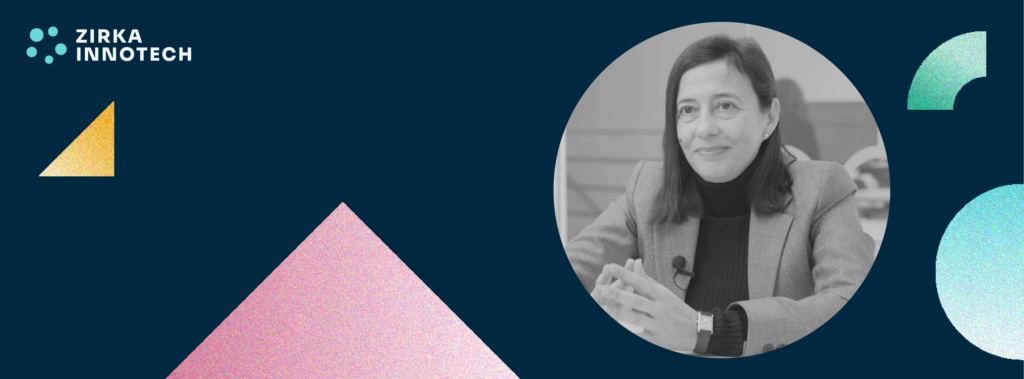
In this article, Full Professor Rosario Vidal from Jaume I University reflects on the critical turning points of her career and the richness that comes with working with diverse teams.
What is your current role, and in which area of science, technology, or innovation do you work?
I’m a Full Professor of Engineering Projects at Jaume I University, and I conduct my research at the Institute of Advanced Materials (INAM). My work focuses on sustainability analysis for new materials and processes, primarily using Life Cycle Assessment (LCA) methodology. Lately, I’ve been focusing on the sustainability assessment of new materials and processes for energy, like halide perovskites, but over the years my work has spanned a lot of different fields, from polymers to water, transportation, food, batteries, and waste valorisation.
What first sparked your interest in this field or motivated you to pursue a career in science, technology, or innovation?
I know my story might sound a bit hard to believe, but I promise it’s true! It’s all thanks to two major opportunities led by women that I was lucky enough to seize.
The first happened when I was about 16. My high school history teacher mentioned that a colleague of hers, Inma Insa, a natural sciences teacher at another high school, was looking for volunteers to start a joint nature study group. That was the real beginning of my scientific career. I learned plant taxonomy, ecology, geology… basically whatever was needed. We studied a unique ecosystem called “La Teixera d’Agres” and we won a runner-up prize at the Prince of Asturias International Awards for young researchers. I was only 18 and hadn’t even started university yet! We also studied atmospheric pollen and went on all sorts of adventures. Later, in university, I moved toward engineering, but I kept seeking out those “adventures” in environmental issues, just through a more industrial lens. I’m infinitely grateful to Inma; she truly changed my life.
My second big breakthrough came while I was doing part of my PhD at the Ohio Environmental Protection Agency (EPA) in the United States. In the lobby, they had reports on display written by the centre’s researchers. I stumbled upon some publications by Mary Ann Curran on Ecodesign and Life Cycle Assessment. At the time, I was already teaching a course on the relationship between products and the environment, and her work completely opened a new perspective for me. I immediately brought those ideas back to my university, making it the first time LCA methodology was introduced in official studies in Spain. From that point on, it became my primary research focus.
“Success comes with a price: in addition to having skills you have to study and work hard. If you want to stand out, you must put in the work.”
From your experience, what has it been like to work in this sector as a woman?
Back in the nineties, there were very few women in engineering. I remember being a fellow at the Valencia Polytechnic University, working on modelling the piping network for a major steel plant. There were no locker rooms for women in technical roles. My professor had to stand guard at the door while I changed to make sure no men walked in. At the time, the only women on-site were in cleaning or office roles.
Even at the university, there were very few of us studying engineering. To be honest, there was still a segment of society that looked down on it; it was seen as a male profession. Thankfully, that perception has shifted over time, and I’d say that today, those differences have largely disappeared.
What is one of the most important lessons you have learned throughout your professional career?
I’ve been fortunate to have a very intense and varied career. It can be stressful at times, but it’s never boring. I’ve worked on over a hundred projects, and each one is a brand-new story. I still have that hunger to learn; whenever someone pitches a new project idea to me and I like it, I find it very hard to say no!
In your view, what do women contribute to the science and innovation ecosystem?
I’ve met so many brilliant women doing top-tier science and innovation. Diversity is wealth!
At INAM, we have many women, both as full professors and PhD students, some coming from places as culturally distant as Iran, Kenia or Pakistan. Working alongside them is incredibly rewarding.
What advice would you give to girls and women who are considering a career in science or innovation?
Go for it! The possibilities are endless, and you get to set your own limit. Success comes with a price: in addition to having skills you have to study and work hard, but that’s true for science, innovation, art, humanities, or sports. If you want to stand out, even just a little bit, you must put in the work.